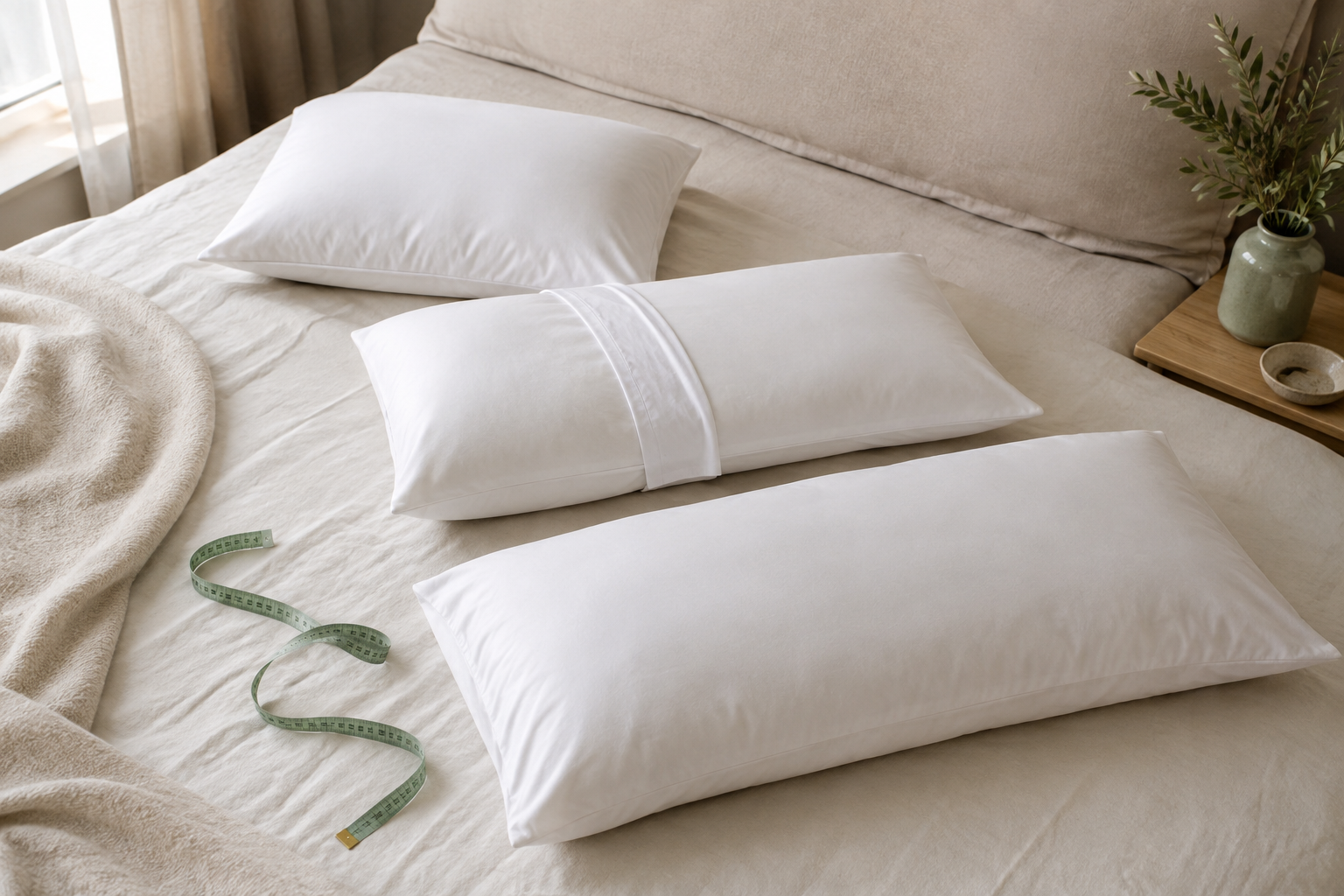
Common US pillowcase labels are useful starting points, not universal finished measurements. A standard case is commonly listed around 20 by 26 inches, a queen around 20 by 30 inches and a king around 20 by 36 inches, but current products from Casper, Brooklinen, Purple and Slip show that real cases can be longer. Measure the pillow seam to seam, compare that with the seller's finished case dimensions and check the closure before ordering. This guide is a sizing reference based on published specifications, not a hands-on fabric test.
Start with the insert dimensions in our complete pillow size chart, then use the checks below for the removable case.
If cleanliness is the main goal, compare a decorative case with a zippered barrier in our pillow protector guide.
Pillowcase size chart for common US labels
Use 20 x 26 inches (51 x 66 cm) for standard, 20 x 30 inches (51 x 76 cm) for queen and 20 x 36 inches (51 x 91 cm, commonly rounded to 92 cm) for king as category reference points. A common body-pillow reference is 20 x 54 inches (51 x 137 cm), while Euro cases are commonly square at 26 x 26 inches (66 x 66 cm). These figures describe familiar labels; they are not a promise that every finished retail case has exactly those measurements.
Current listings demonstrate the variation. Casper's Percale case is published at 21 x 29 inches for Standard and 21 x 37 inches for King. Brooklinen lists its silk case at 20 x 27 and 20 x 37 inches. Purple lists SoftStretch cases at 20 x 30 and 20 x 40 inches, while Slip uses 20 x 30 for its Standard/Queen and 20 x 36 for King. The label alone therefore cannot settle the fit.
- Standard reference: 20 x 26 in (51 x 66 cm)
- Queen reference: 20 x 30 in (51 x 76 cm)
- King reference: 20 x 36 in (51 x 91–92 cm)
- Body-pillow reference: 20 x 54 in (51 x 137 cm)
- Euro reference: 26 x 26 in (66 x 66 cm)
Measure the pillow and the case separately
Place the fully expanded pillow on a flat surface. Measure its width and length in a straight line from seam to seam without following the curved top. Then measure the empty case flat from its stitched boundaries. If an envelope flap folds inside, record the usable internal length rather than treating the flap as extra pillow space.
For a gusseted pillow, also measure the side-panel depth. For a molded contour, record the longest and widest points and check whether the maker requires a shaped cover. A pillow labeled Standard can still have a 17-inch width, a tall contour or a broad shoulder cutout that changes how a conventional flat case behaves.
- Measure seam to seam with the pillow expanded, not compressed
- Record length, width and—when relevant—gusset or contour height
- Compare with finished product dimensions, not only the package label
- Check whether dimensions include decorative flanges or an internal envelope flap
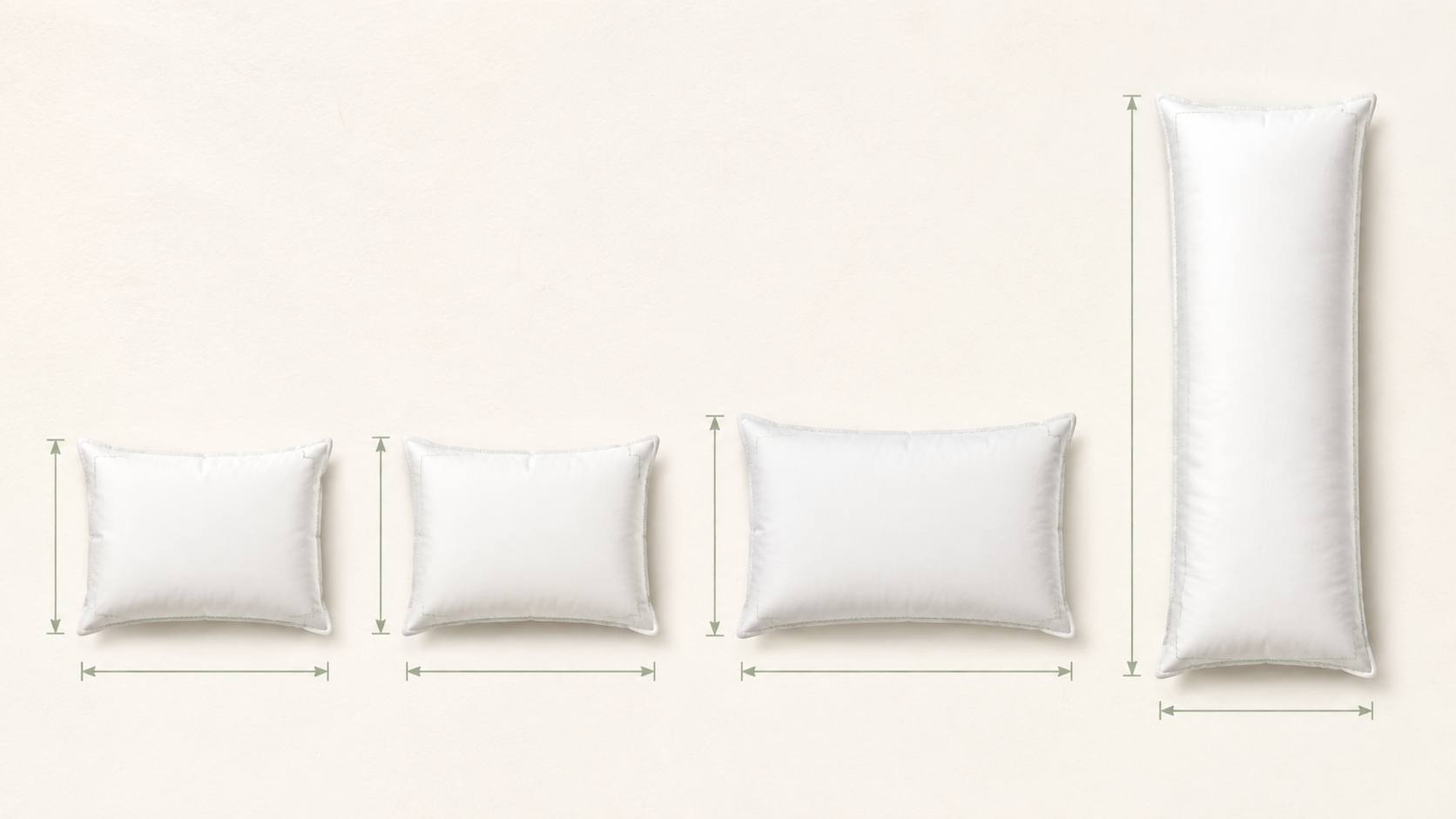
Standard versus queen: when one case can cover both
A 20 x 30-inch queen pillow physically needs more length than the 20 x 26-inch category reference for a standard case. Some brands solve this by selling a roomier Standard/Queen case. Slip, for example, publishes one 20 x 30-inch Standard/Queen size. Other brands sell a Standard case near 27 or 29 inches long, which may cover some queen inserts but will produce a snugger result.
A concrete fit test is more useful than the label: slide the pillow in without folding or forcing a corner, close the envelope or zipper, then leave it flat for ten minutes. If the shell bows, the ends curl inward or the pillow becomes noticeably taller and firmer, the case is applying compression. If several inches of empty fabric collapse beyond the insert, the case is unnecessarily loose.
Need a barrier beneath the pillowcase?
A correctly sized zippered protector can add a washable layer beneath the decorative case. Check the selected size and current Amazon listing before ordering.
King, body and specialty cases need exact dimensions
Do not place a king pillow in a conventional standard case. The common reference lengths differ by ten inches, and even generous standard cases remain much shorter. Current king cases also vary: the examples above range from 36 to 40 inches, so confirm whether the extra fabric is intentional for an envelope closure or simply a longer finished cut.
Body pillows, pregnancy pillows, CPAP pillows, travel pillows and cervical contours are less predictable. A nominal 20 x 54-inch body case is useful only when the insert has a similar rectangular footprint. U-, C- and J-shaped pregnancy pillows need model-specific covers. A CPAP or ear-hole pillow can lose its functional cutouts beneath a conventional case, so use the brand's mapped cover when its geometry matters.
Closure and fabric change the practical fit
An open-ended case needs enough length to cover the insert without exposing it during movement. An envelope closure needs additional fabric to overlap internally. A zipper gives a clearer boundary but can feel tight when the insert is overfilled. None of these designs is automatically better; compare the usable cavity, seam placement and washing instructions.
Natural fibers can change after laundering, but the amount depends on fabric construction and the manufacturer's finishing process. Follow the care label rather than adding a universal shrinkage allowance. Wash and dry within the stated limits before deciding that a new case is too loose, and do not use hotter settings merely to force a smaller fit.
A five-step buying check
First, read the insert's sewn-in label or official specification. Second, verify the seller's finished case dimensions. Third, identify open, envelope or zipper closure. Fourth, compare care instructions with how you actually wash bedding. Fifth, keep the packaging until the clean, unwashed fit has been checked.
This article intentionally does not rank pillowcases. Size labels alone cannot establish fabric quality, temperature feel or durability, and mixing those shopping questions into a dimension chart would turn a precise reference page into a generic product list. If you need liquid or allergen protection rather than a decorative sleep surface, use a correctly sized zippered protector beneath the case and verify both layers independently.
- Confirm the pillow's actual footprint
- Read the case's finished dimensions
- Account for the closure
- Follow material-specific care
- Reject compression, curling corners or excessive empty fabric
Frequently asked questions
What size pillow fits in a 20 by 30 pillowcase?
A common queen pillow measures about 20 by 30 inches, so that is the direct label match. Some standard pillows also fit with extra length. Check the finished case and pillow dimensions plus the closure, because a 20-by-30 label does not describe every usable internal cavity.
What are the standard sizes for bed pillowcases?
Common US reference sizes are 20 by 26 inches for Standard, 20 by 30 for Queen and 20 by 36 for King. Retail dimensions vary: current brand examples run longer than those references, so verify the selected product rather than relying only on the name.
What is a regular size pillowcase?
Regular usually means Standard in the US, commonly referenced as 20 by 26 inches. Some bedding sets use a combined Standard/Queen size or make their Standard case several inches longer.
How much bigger should a pillowcase be than the pillow itself?
There is no universal extra allowance because open, envelope and zippered constructions use fabric differently. Choose a case that accepts the insert without folding or compression, closes as designed and does not leave excessive empty fabric. Compare the brand's finished and usable dimensions.
Sources
About the editorial team
The Pillow Advisor checks product specifications, care instructions and reliable expert sources. We do not invent hands-on testing or medical claims.